
AB 645 Speed Safety Systems – Why California Can’t Afford to Wait
Updated as of Tuesday evening, 12/16/25
Speeding remains one of the leading causes of traffic deaths in California. The Assembly Bill (AB) 645 Speed Safety Systems pilot program was designed to address it head-on. The bill authorizes a five-year pilot program to implement a predetermined number of automated speed cameras across six pilot cities (San Francisco, Oakland, San Jose, Glendale, Los Angeles, and Long Beach), along with Malibu, which was added to the bill a year later. With this program, the state created an opportunity to test a proven, life-saving tool already in use by cities across the nation, such as Seattle, Philadelphia, and New York.
Yet, as of today, implementation progress varies dramatically from city to city, and the delays continue to put the lives of residents and anyone who walks, bikes, or drives in the city at risk.
In 2023, the California State Legislature passed AB 645, designating six cities to implement a five-year pilot speed-safety camera program. The program allows a limited number of speed camera systems on high-injury networks (streets with the highest injury and death rates), school zones, and street-racing corridors. The bill’s cosponsors – SAFE, Streets For All, and Walk San Francisco – worked to ensure equity and privacy measures were built into the bill. This enables each city to properly implement non-police measures to enforce speeding regulations and save lives. SAFE also ensured that any revenue generated from speeding drivers could only be used to fund badly needed road safety improvements across the city, such as new crosswalks and speed humps around schools and in residential neighborhoods.
To help create more transparency around the program and implementation process, in 2025, SAFE created key documents outlining key details, an Implementation Checklist, and an Implementation Flowchart to guide city staff.
Steps to Implement the Speed Systems Pilot Program
There are several steps a city must take to implement the Speed Systems program, as laid out in AB 645. These steps, as outlined in our Implementation Checklist, are to ensure proper awareness time for residents and to ensure city staff are properly trained. These steps, in brief, are detailed below:
Ensure Eligibility for Program Implementation – For a city to implement the AB 645 Speed Safety Systems pilot program, they must first be identified as one of the six pilot cities (San Francisco, Oakland, San Jose, Glendale, Los Angeles, and Long Beach) or have themselves added in a subsequent piece of legislation, as Malibu did with Senate Bill (SB) 1297.
Develop an Implementation Plan – The city must develop a Speed Safety System Use Policy and Impact Report that outlines camera locations, signage, data-handling procedures, and privacy protections. It must comply with all state requirements, including limits on data storage and use.
The city can also begin identifying eligible camera locations that meet the criteria of being a designated high-injury corridor, a street with four or more street racing or takeover incidents, or a school zone.Conduct a Public Process – A city website will publish the Use Policy and Impact Report and include additional details on the program for public awareness. Cities must hold at least one public hearing and provide opportunities for community input before installing cameras.
Vendor Selection – The city can begin moving forward with its vendor selection either through a Request for Proposal (RFP) process or using the contract from another pilot city (an action called “piggybacking”).
Train City Staff and Establish Equity Measures – City staff must be properly trained to administer the program and manage all data in accordance with privacy and security standards. In addition, the legislation requires cities to provide a diversion program and offer payment plans to ensure the program is equitable and does not disproportionately impact lower-income residents.
Launch a 30-Day Warning Period – Once cameras are installed, the city must issue warning notices — not citations — for the first 30 days to inform drivers of the program.
Begin Enforcement – After the warning period, the city can begin issuing citations to drivers exceeding the speed threshold (11 mph or more over the posted limit).
What is the status of each city’s program implementation?
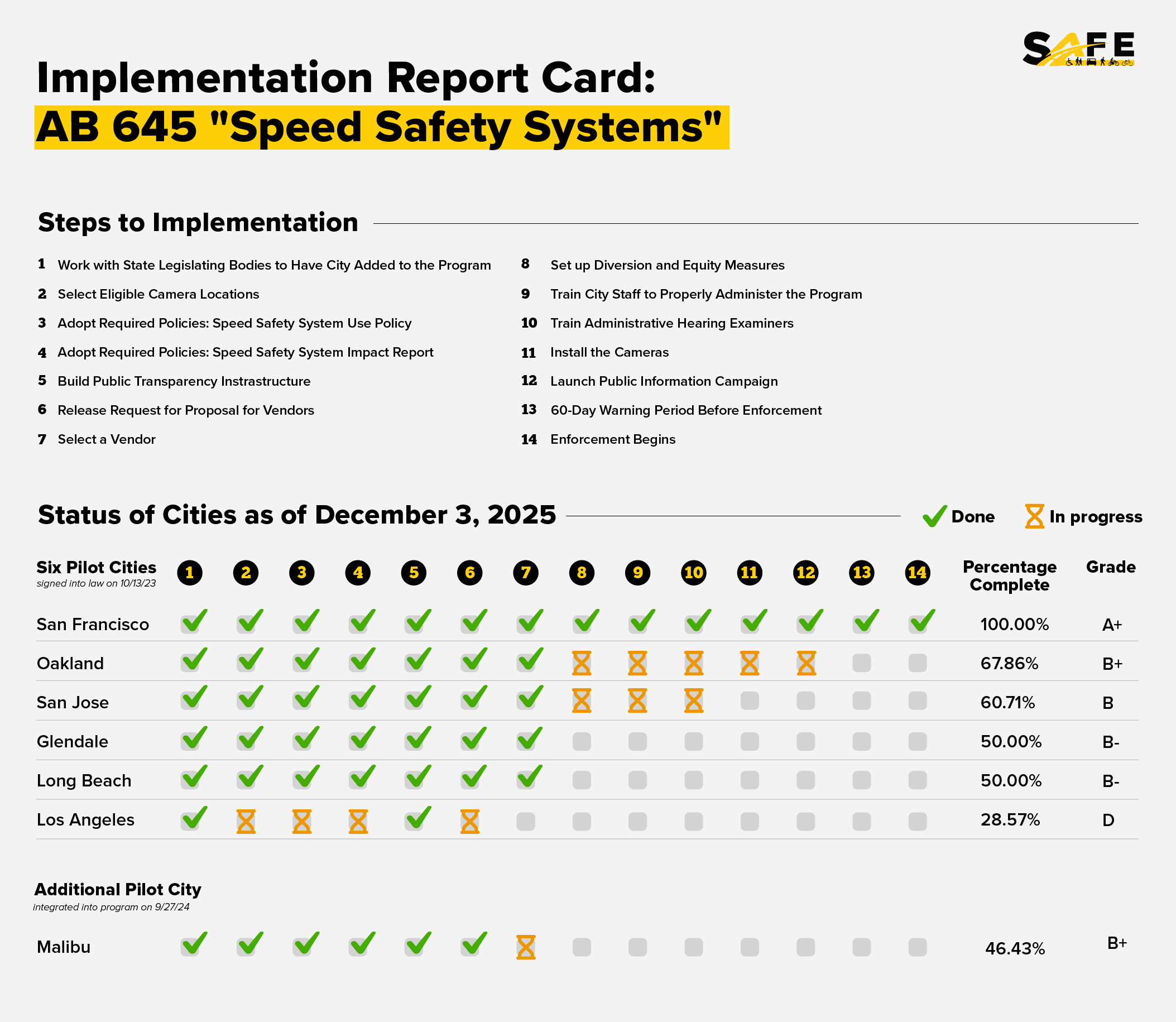
SAFE gathered feedback from each pilot city to understand their progress toward implementing AB 645. The Report Card below compares the status of each city as of October 2025, with grades based on how far along each is in making the program fully operational. SAFE evaluated each implementation step to determine whether a city had taken no action, was in progress, or had completed the required step. This assessment was then used to calculate each city’s overall progress toward full implementation and to assign a grading score.
Six Pilot Cities
San Francisco (Grade: A+)
Program website: Speed Safety Cameras | SFMTA
Number of cameras: 33
Percentage complete: 100%
Current status: Completed, all cameras issuing citations
San Francisco is the clear leader, issuing its first warning tickets on March 20, 2025, and issuing its first citations in August. A recent report from SFMTA showcases the program’s success in slowing speeds and stopping recidivism, with speeding reduced by an average of 72% among 15 key camera locations. Within its first 6 months of operation, over 400,000 warning notices were issued from March to August. Since July, the city has seen consistent week-over-week declines in violations, demonstrating that these systems are successfully creating behavior change (safer, slower drivers).
The difference between the speed of San Francisco’s implementation and the lack of speed in other cities is that San Francisco prioritized the implementation of speed safety cameras, starting the day after Governor Newsom signed AB 645, knowing that this was the most effective way they could save lives and raise funds for other badly needed road safety improvements.
This program is a clear win for the city and its residents. With fewer speeding drivers, this ensures roadways are safer for all pedestrians, cyclists, and drivers alike.
Oakland (Grade: B+)
Program website: Speed Safety Cameras Pilot Program | City of Oakland, CA
Number of cameras: 18
Percentage complete: 67.86%
Current status: Installing cameras and beginning public awareness campaign.
Oakland is the next closest city to implementing its speed program. Oakland’s Department of Transportation presented its intention to have the program live and issuing warnings by the end of 2025. It is currently on track to do so.
San José (Grade: B)
Program website: Speed Safety Cameras Pilot Program | City of San José
Number of cameras: 33
Percentage complete: 60.71%
Current status: Finalizing program details and training city staff.
San José approved its System Use Policy and Impact Report on 10/29/2024 and finalized a vendor for the program. The city is now in the process of ensuring the program can be properly administered by its staff before installing its 33 cameras.
Glendale (Grade: B-)
Program website: Glendale Speed Safety Program (AB 645)
Number of cameras: 9
Percentage complete: 50%
Current status: Will be finalizing program details and training city staff.
At its City Council meeting on December 16, the City voted to authorize a vendor contract to move forward with implementation of the program. The City will now work to ensure the program can be properly administered by staff before installing its 9 cameras.
Long Beach (Grade: B-)
Program website: Long Beach Automated Speed Enforcement System Program
Number of cameras: 18
Percentage complete: 50%
Current status: Will be finalizing program details and training city staff.
Long Beach approved its System Use Policy and Impact Report at its City Council meeting on December 16. The Council also voted to authorize a vendor contract. The City will now move forward with ensuring the program can be properly administered by staff before installing its 18 cameras.
Los Angeles (Grade: D)
Program website: Speed Safety System | Los Angeles Department of Transportation
Number of cameras: 125
Percentage complete: 28.57%
Current status: Drafting System Use Policy and Impact Report.
Los Angeles is the largest of the six pilot cities and has hundreds of fatalities and serious injuries resulting from speeding drivers every year. LA is also currently the slowest city to implement the program, putting millions of lives at risk. Most recently, the LA Department of Transportation presented to the Transportation Committee with an update on the program implementation, including the procurement process for a vendor and the drafting of a System Use Policy and Impact Report. LADOT communicated a timeline to have the program in use by the end of 2026, but they will need to move quickly to meet this target.
Additional City Integrated into the Program
Malibu (Grade: B+)
Program website: Pacific Coast Highway Safety | Malibu, CA - Official Website
Number of cameras: 5
Percentage complete: 46.43%
Current status: Next step is working on the RFP for vendor selection.
The City of Malibu is a unique city within the Speed Safety Systems program. It was not initially identified as one of the six pilot cities when AB 645 was passed in 2023. However, after the City Council declared a Local Emergency on 11/13/2023 to address extremely dangerous conditions along Pacific Coast Highway in the city, they moved to be added to the program via SB 1297, signed by Governor Newsom on 9/27/2024. Having approved the System Use Policy and Impact Report earlier this year, as well as releasing the Request for Proposal for vendors. They are now moving forward with identifying a vendor for the program.
Why Local Residents Should Care
The uneven rollout highlights a troubling discrepancy throughout our state. While San Francisco residents are already benefiting from safer streets, millions in Los Angeles, Long Beach, and Malibu, cities with some of the highest crash rates in the state, remain exposed to preventable traffic violence. A report published by the SFMTA found that the first six months of the program being live have seen a 72% reduction in speeding across 15 key locations. Imagine that being the case not only in one city but in all seven.
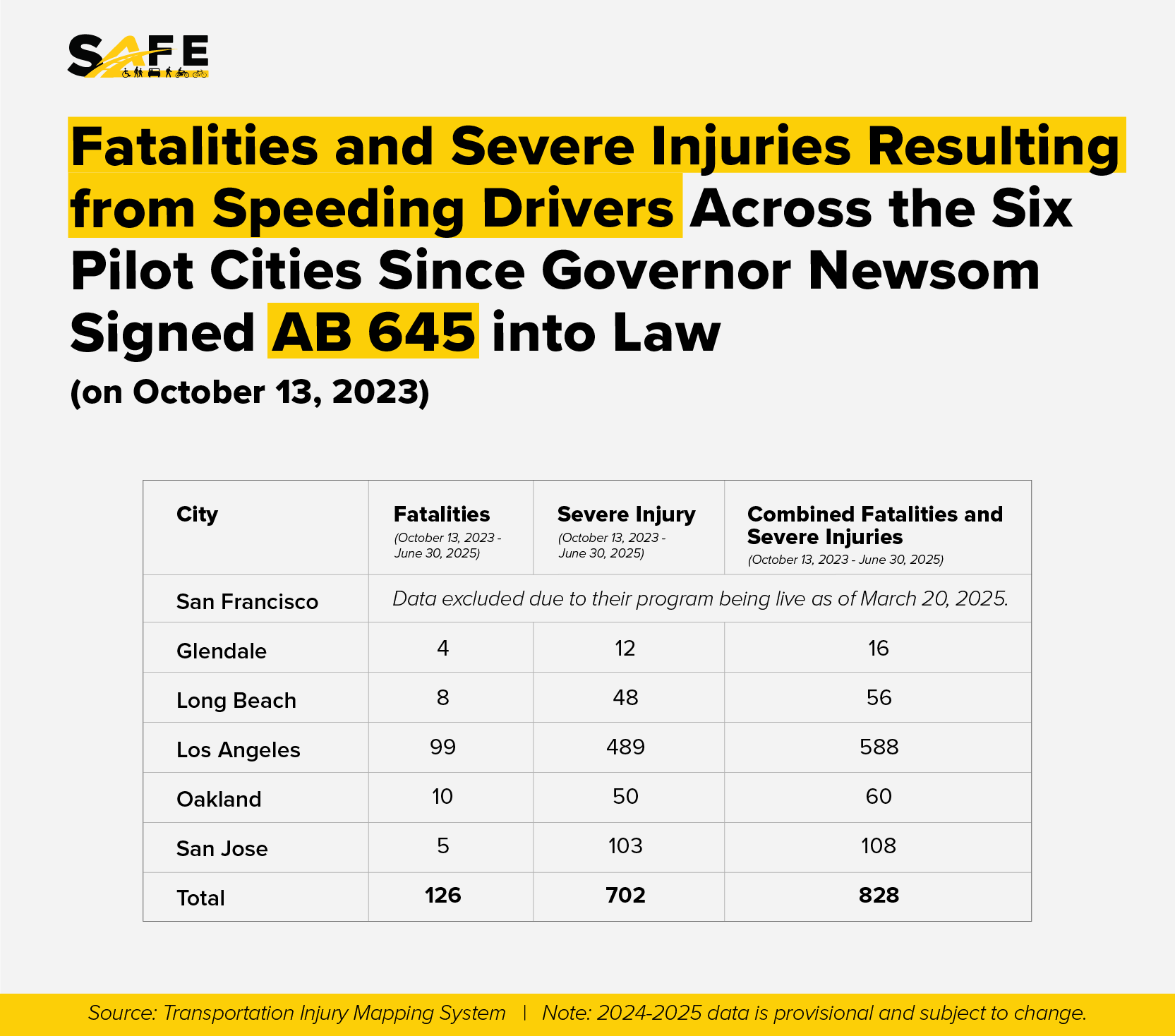
Here you can see the impact that speeding drivers and unsafe roadways have across the six pilot cities. The numbers in the chart represent far more than statistics. They reflect people with families, friends, and loved ones whose lives have been forever changed.
Every month of delay represents more lives lost. SAFE is urging local leaders to double down on this program and treat AB 645 with urgency. Cities that are lagging need to fast-track vendor selection, equity measures, and public outreach without cutting corners. Automated speed safety systems have been proven across the country to reduce speeding and fatal crashes. The sooner these systems are operational, the sooner we save lives. Road safety can’t wait.