
Forest Lawn Drive: How Los Angeles is Keeping a Dangerous Road Unsafe
Los Angeles is known for its beautiful weather, fast cars, and dangerous roads. And when I say dangerous, I’m not just talking about how many potholes are on Wilshire Blvd, but how many people die each year due to traffic violence.
In fact, for the past three years, more people have died in LA due to traffic violence than from homicides. A majority of these are pedestrians.
One might wonder why LA’s roads are SO dangerous. There are many reasons; ultimately, it comes down to what those in charge prioritize. More recently, the priority has been to reduce homelessness and violent crime, and the result is that violent crime has gone down a lot and homelessness…well, that’s a whole other mess. Over the past few years, the annual budget for police enforcement has skyrocketed, and they spend close to one billion annually on homeless care. The same can’t be said about road safety, even when more people die in traffic collisions in LA than homicides. The contrast is clear when comparing the City’s 2025 budget to its budget in 2021:
To address crime: LAPD received $1.987 billion, compared to its $1.76 billion budget in 2021-22, a 12.9% increase.
To address homelessness: the City allocated $953.3 million to homelessness-related programs and services.
To address traffic violence: LA DOT received a paltry $1.805 million specifically for the Vision Zero Program, the City’s promise to eliminate traffic deaths through safety improvement projects. This is down from its $4.389 million budget in 2021-22, a 58.9% decrease in funding.
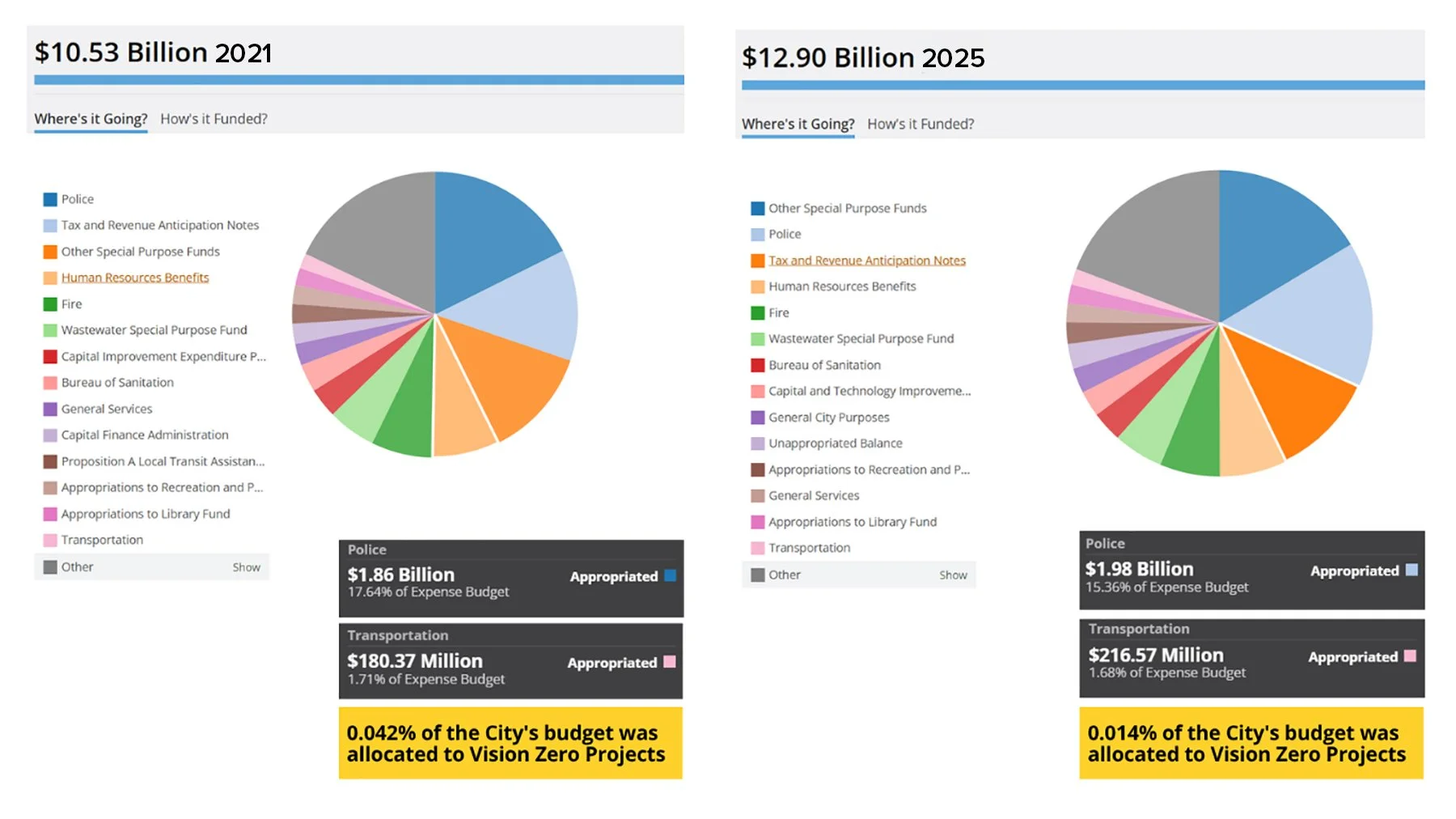
Pie charts comparing LA’s 2021 and 2025 budgets. SOURCE: openbudget.lacity.org.
Los Angeles has money to significantly reduce the impacts of traffic violence, but these budgets show that road safety is clearly not a priority.
And then there’s the story of Forest Lawn Drive near Griffith Park, a fully funded road safety project. Forest Lawn Drive is a sort of case study that highlights why our roads in LA are so dangerous and why our leaders are keeping them that way.
How Dangerous is Forest Lawn Drive?
Forest Lawn Drive has long been known to be a dangerous road around Griffith Park. Every day, thousands of cars take a detour from the 134 Freeway to avoid rush-hour traffic. At night, the wide, gently curving road becomes even more dangerous as drivers speed through it.
Per the Los Angeles Department of Transportation, between 2013 and 2023, 95 collisions were reported in this area, including crashes that severely injured or killed 3 people.
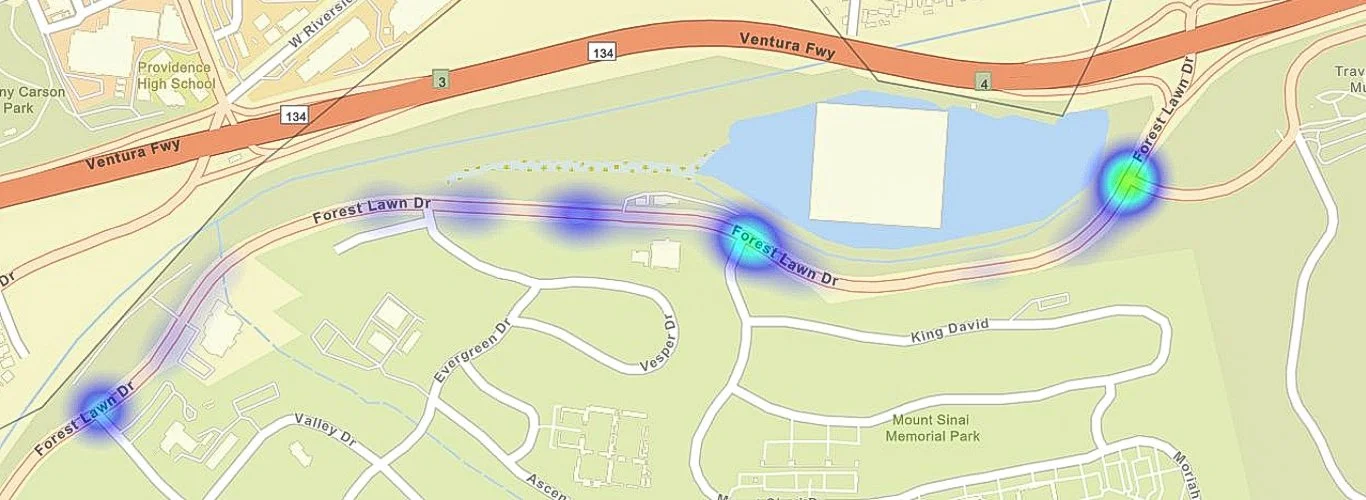
Heat map showing the locations of 95 reported collisions between 2013 and 2023. SOURCE: LA DOT
While it’s one of the main routes for cyclists going to and from the San Fernando Valley, it’s not a safe route. There is a roughly 1-mile eastern stretch of Forest Lawn Drive (from Zoo Drive to the entrance of the Forest Lawn Cemetery) which has no sidewalk, no bike lane, a broken-up shoulder, and a speed limit of 45 MPH – meaning cars regularly go a lot faster.
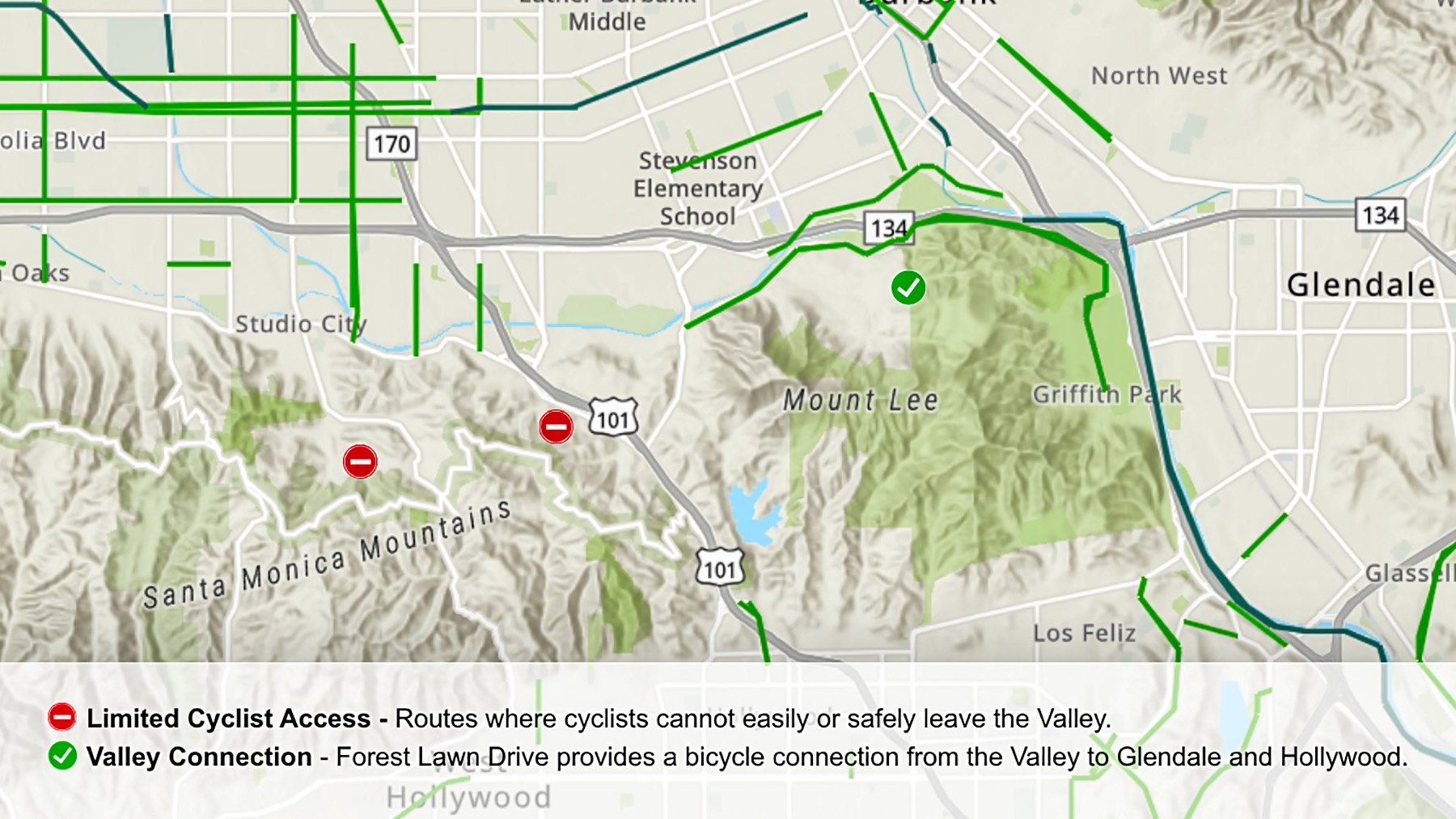
Map showing cycling access from the East San Fernando Valley to Glendale and Hollywood.
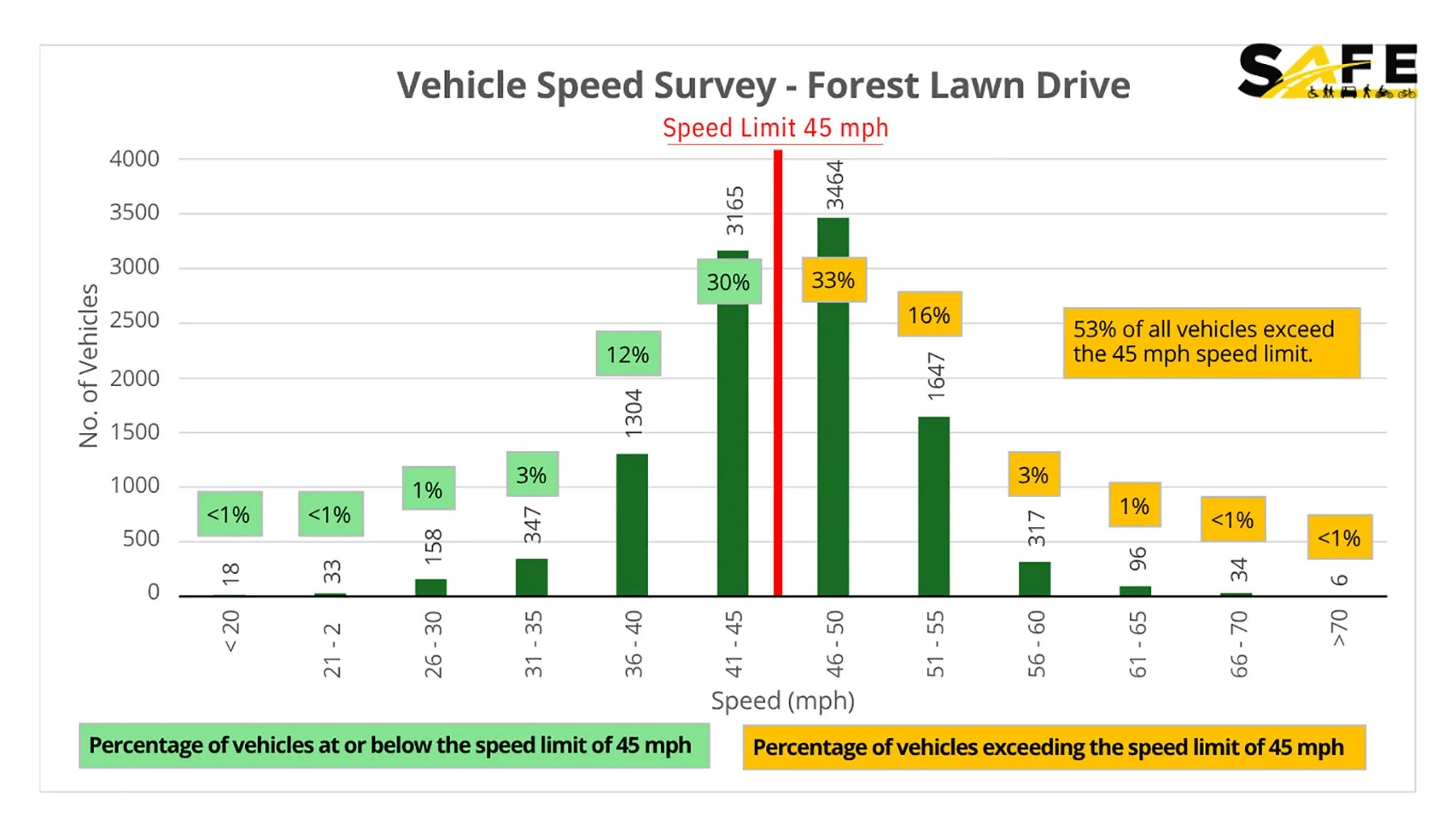
Between June and August 2026, SAFE volunteers conducted 14.5 hours of independent speed surveys on Forest Lawn Drive, measuring how fast drivers are actually going and bicycle and pedestrian counts to document how many people use this stretch of road.
The results further exemplified the need to address speeding and safety on this road. 53% of surveyed vehicles were traveling above the posted 45 mph speed limit, with 20% traveling between 51 mph and 75 MPH, just inches away from people walking, running, and biking. (See Appendix.)
The bicycle and pedestrian counts (runners and walkers) showed that despite the lack of safe cycling infrastructure and no sidewalk, this road is regularly used for commuting or recreation during daylight hours. Over the course of 13.5 hours of daylight surveys, an average of 6.5 cyclists or pedestrians were seen per hour or roughly 91 individuals per day. (See Appendix.)
This is more than many roads in Los Angeles with bicycle lanes and illustrates the fundamental safety problem on Forest Lawn Drive: pedestrians and cyclists must share a road with vehicles traveling at high speeds, with no physical protection or buffer between them.
Can’t We Just Change the Speed Limit or Add Speed Humps?
Changing a number on a sign won’t solve Forest Lawn Drive’s speeding problem; the road itself is designed to encourage drivers to speed, and the City’s own data confirms it.
Per California law, the City cannot simply post a much lower speed limit: California generally requires cities to establish speed limits through an engineering and traffic survey, with the 85th-percentile speed serving as the primary benchmark. This statistical measurement (85th percentile) represents the speed of 85% of drivers and dictates the speed limit that can be legally posted. On Forest Lawn Drive, that speed is 49 mph. Under the rules currently applicable to the corridor, LA DOT says that means the City can only set the posted limit at 45 mph, and cannot simply drop it to 35 or 40 mph.
That 45 mph limit also prevents LA DOT from using common traffic-calming tools like speed humps, which are not permitted on streets with a 45 mph speed limit.
California has changed these rules in recent years to give cities more flexibility to lower speed limits for safety in certain circumstances, but a roadway must meet specific criteria to use those exceptions. LA DOT's Forest Lawn Drive FAQs state that Forest Lawn does not currently meet the criteria for a further reduction.
To reduce actual driving speeds and protect the many cyclists and pedestrians who use the road, a new design was needed. If the new design lowers overall speed, the City would have an opportunity to establish a lower, safer speed limit. This may not make sense to most people, but it's how the law is currently written.
Forest Lawn Drive Safety and Mobility Project Overview
In 2023, Councilmember Nythia Raman decided to address the dangers of Forest Lawn Drive when she directed LA DOT to launch the Forest Lawn Drive Safety and Mobility Project.
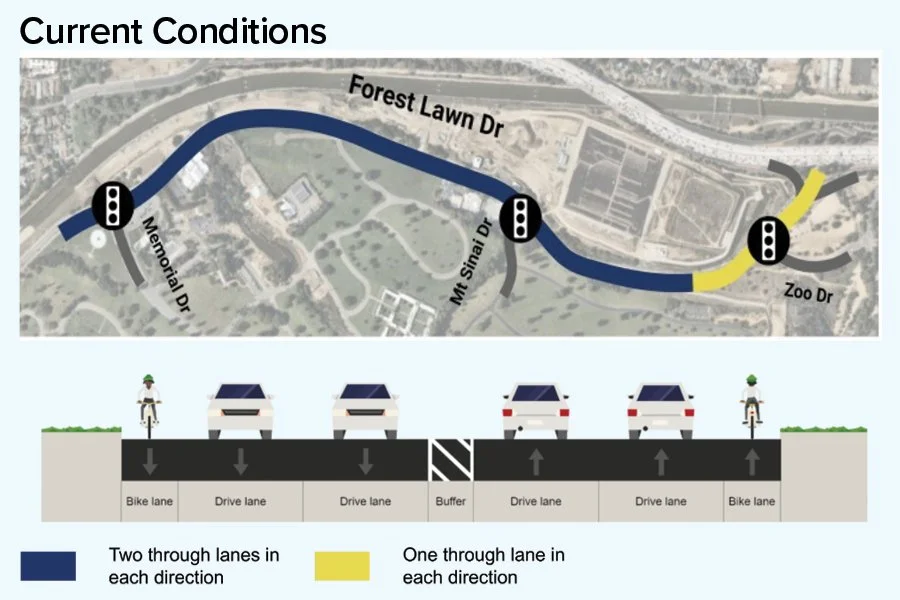
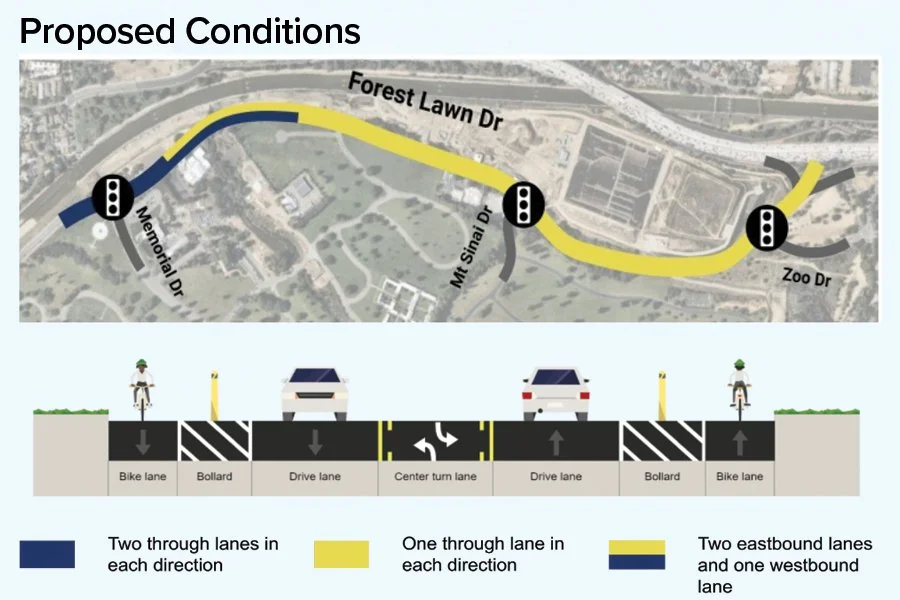
These diagrams and maps compare the existing road design on Forest Lawn Drive with the proposed improvements from the Forest Lawn Drive Safety and Mobility Project.
The City's proposed solution was to redesign 1.05 miles of roadway to make it safer for both cars, cyclists, and pedestrians. To do this, they needed to reduce speeding, prevent unsafe lane changes, and separate speeding cars from pedestrians and cyclists.
This solution was designed after extensive input from community members and the businesses along this route, including Forest Lawn Cemetery and Mount Sinai Memorial Park and Mortuary.
Changes for drivers would have included:
The current two travel lanes in each direction would be redesigned into single travel lanes each way, with a center turn lane and dedicated left-turn pockets. These dedicated turning areas give drivers a safer place to slow down and turn without blocking through traffic.
The single lane discourages unsafe lane changes and excessive speeding.
A center turn lane provides additional space for vehicles turning into nearby businesses, helping create more predictable traffic movements along the corridor.
Extended turning space specifically for those taking a left into Forest Lawn Cemeteries to prevent traffic congestion.
Cyclists and pedestrians would have gotten some safety protection:
Dedicated bike space provides separation from moving traffic, creating a physical buffer between cyclists and moving vehicles.
The separated bike lanes would make the corridor significantly safer for people walking and jogging along the roadway.
The separated bike lanes would connect Forest Lawn Drive with other existing bicycle facilities, including a pre-existing bike lane on the western end of Forest Lawn Drive, the LA River Bike Path, Zoo Drive Bike Lanes, and Crystal Springs Drive Bike Lanes, creating a continuous network of safer bicycle and pedestrian trails through and around Griffith Park.
The improvements would have made the road significantly safer for all users. While the fastest drivers would no longer be able to speed, LA DOT found that the design changes wouldn’t significantly affect the average driver's travel time through that section of road. In most cases during peak road use, predicted travel time increase would be less than 12 seconds. On the weekend, predicted eastbound travel (but not westbound travel) delay could be as much as 1 minute and 36 seconds.
The project, funded through the City's existing resurfacing and restriping budget, was developed through an extensive public outreach process beginning in spring 2023, including surveys, stakeholder meetings, community events, and additional outreach. More than 700 people responded to the City's August 2023 survey, followed by more than 250 additional comments submitted in late 2024.
Politically Induced Pause
After nearly three years of community input, the City was finally preparing to move forward with the project. Construction was funded and planned to begin in early May 2026 but was rescheduled for June to avoid busy days for the two cemeteries that share this road on Mother’s Day or Memorial Day.
Shortly before repaving and safety improvements were set to begin, Mayor Karen Bass stepped in and directed LA DOT to stop and review the project. Many community members, road safety advocates, and those who use the road, especially the cyclists and pedestrians most at risk, were shocked.
After submitting public requests to further investigate this decision, Streets For All found that Forest Lawn and Mount Sinai cemeteries had been lobbying state representatives to intervene and preserve all four car lanes. Concerned that the expected 12 seconds of delay that this new safety project might cause would upset their customers (who would apparently prefer to speed to the cemetery than drive safely), they successfully lobbied legislators in Sacramento, who then asked Mayor Bass to halt the project.
In the letter dated 7 May, Mayor Bass ordered the following:
“1. Develop a conceptual design plan and cost estimate for project alternatives that maintain all current traffic lanes while upgrading existing bicycle facilities no later than Friday, June 12, 2026.
2. Provide an implementation timeline and recommended funding strategy to implement the project.
3. Prepare a community and stakeholder engagement plan no later than Friday, June 12, 2026
4. Conduct essential, immediate outreach to gather feedback on the new plan and achieve a resolution for all parties no later than Friday, July 10, 2026.”
We reached out to the LA Mayor’s office to find out what has been completed of these steps, but we have not heard back. That said, after 2 months, there is no indication that any of this has been completed, so Forest Lawn Cemetery and Mount Sinai, with the help of Mayor Bass, have managed to put this important road safety project on hold indefinitely.
(Update 19 August.) Staff from the LA Mayor’s office just sent this response to our inquiry:
“LADOT has developed three project proposals that are currently under evaluation, with no additional updates at this time regarding implementation or resurfacing timelines. Repaving is anticipated following LADOT’s evaluation and finalization of the reconfiguration design.
We recognize the importance of Forest Lawn Drive to the Griffith Park community and the need to ensure that any improvements appropriately address the safety and mobility needs of the community and all stakeholders. As the evaluation continues, my office will remain engaged with LADOT and the community, listening to the concerns and priorities being raised and working to ensure they are appropriately considered as the project moves forward.”
Forest Lawn Cemetery, Not Your Average Nonprofit
Forest Lawn Cemetery (legally known as Forest Lawn Memorial-Park Association) led the effort to stop the safety improvements and provided information to local community members about how these safety changes would wreak havoc on drivers' “rights” to speed through this road. Based on their arguments and the amount of effort they put into stopping it, it seemed like business to Forest Lawn Cemetery might be irreparably harmed, or maybe they were in such financial straits that the loss of even one customer due to a drive that might be delayed by less than 12 seconds could push them into bankruptcy. However, based on their publicly reported finances, this doesn’t appear to be the case.
Forest Lawn Memorial-Park Association, founded in 1906 and headquartered in Glendale, CA, is a nonprofit corporation that doesn’t pay any taxes. In 2024 they had revenue of $239.4 million with expenses of only $171.6 million. That means they had a net income of $67.8 million, with total assets reported at $1.33 billion.
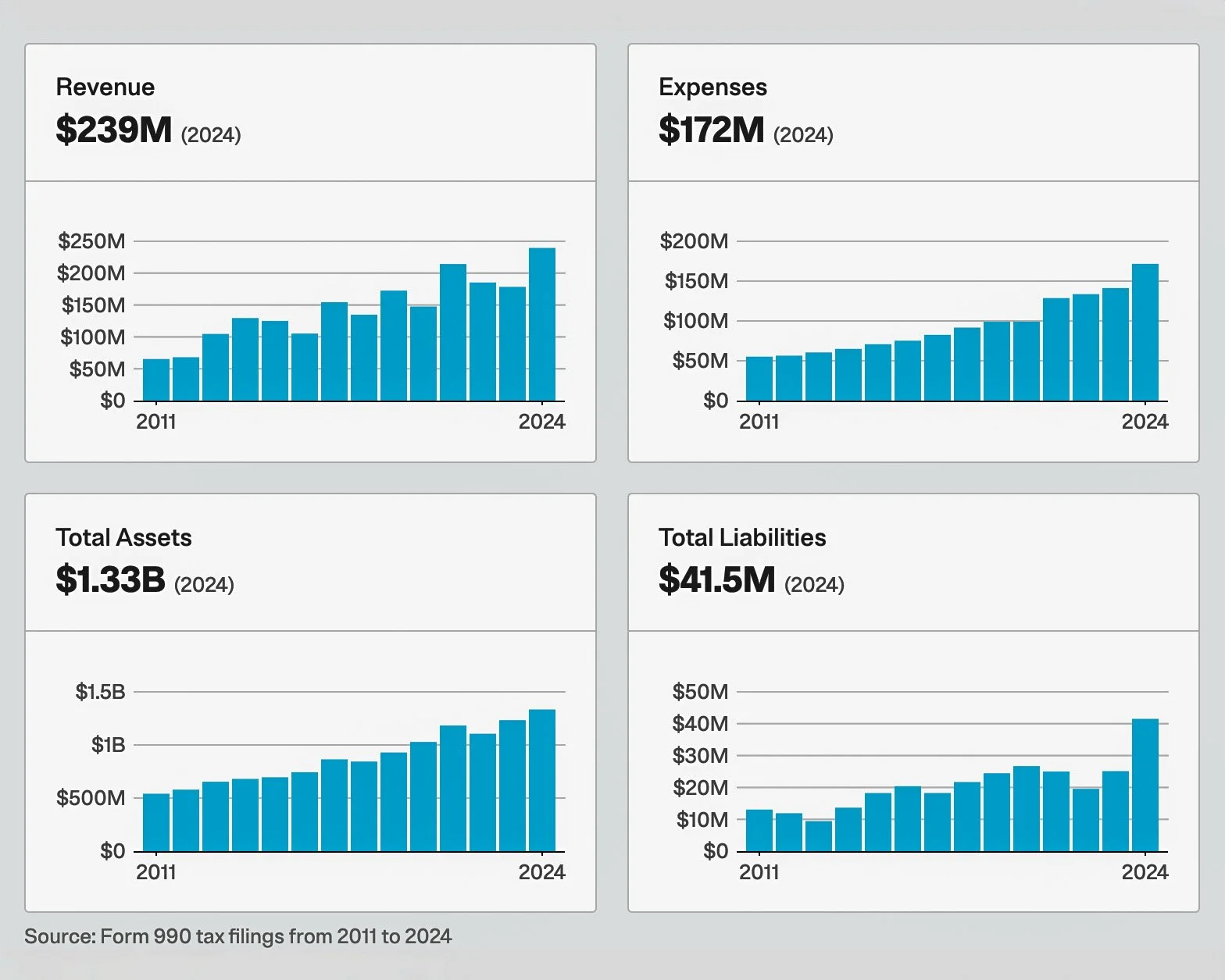
Source: ProPublica Nonprofit Explorer (https://projects.propublica.org/nonprofits/organizations/950743320)
That’s a lot of net income, and when you take into account that they are set up as a nonprofit and don’t have to pay taxes, that $67.8 million is even more impressive.
Forest Lawn Memorial-Park Association is a type of nonprofit called a 501(c)3. This is an IRS tax code and it means they must follow several rules.
While I am not including everything about these rules, there are two that should be known:
1. The Exclusivity Rule (The Purpose)
A nonprofit organization must be organized and operated exclusively for one or more of the specific exempt purposes listed in the statute. If a substantial part of its activities does not further an exempt purpose, its legal status is void. [1,2,3,4,5]
A well-organized nonprofit organization typically spends 65-80% of its annual revenue on its program services, or its stated mission. With $67.8 million in net income after expenses, one would expect Forest Lawn Drive to invest all of it back into the community, but per its own report to the IRS, in 2024 it spent only $20.1 million, or 8.4% of its annual revenue, on mission-based program expenses. What those expenditures went to wasn’t clear.
2. The Private Inurement and Benefit Prohibition
The law explicitly states that no part of the organization's net earnings may inure to the benefit of any private shareholder or individual. [1,2]
Reasonable Compensation: The entity may pay reasonable, market-rate compensation for services rendered, but it cannot distribute profits, dividends, or excessive salaries to insiders, founders, or board members.
Public Over Private: All operations must serve a public benefit rather than the private financial interests of specific individuals. [1,2,3,4,5]
SAFE looked into the pay that their executives and board of directors received, and this is what it found:
In 2024, Forest Lawn CEO Darin Drabing received a salary and additional benefits exceeding $ 2 million.
The 9 members of the Board of Directors, who don’t appear to hold any managerial roles, were paid a total of $1,273,600 for their work. That’s an average of $ 141,000 per board member per year.
The reported pay and compensation for all executives (from Senior Vice President positions on up) working for Forest Lawn Memorial-park Association totaled $8,366,439. That’s an average of $929,000 per person, per year.
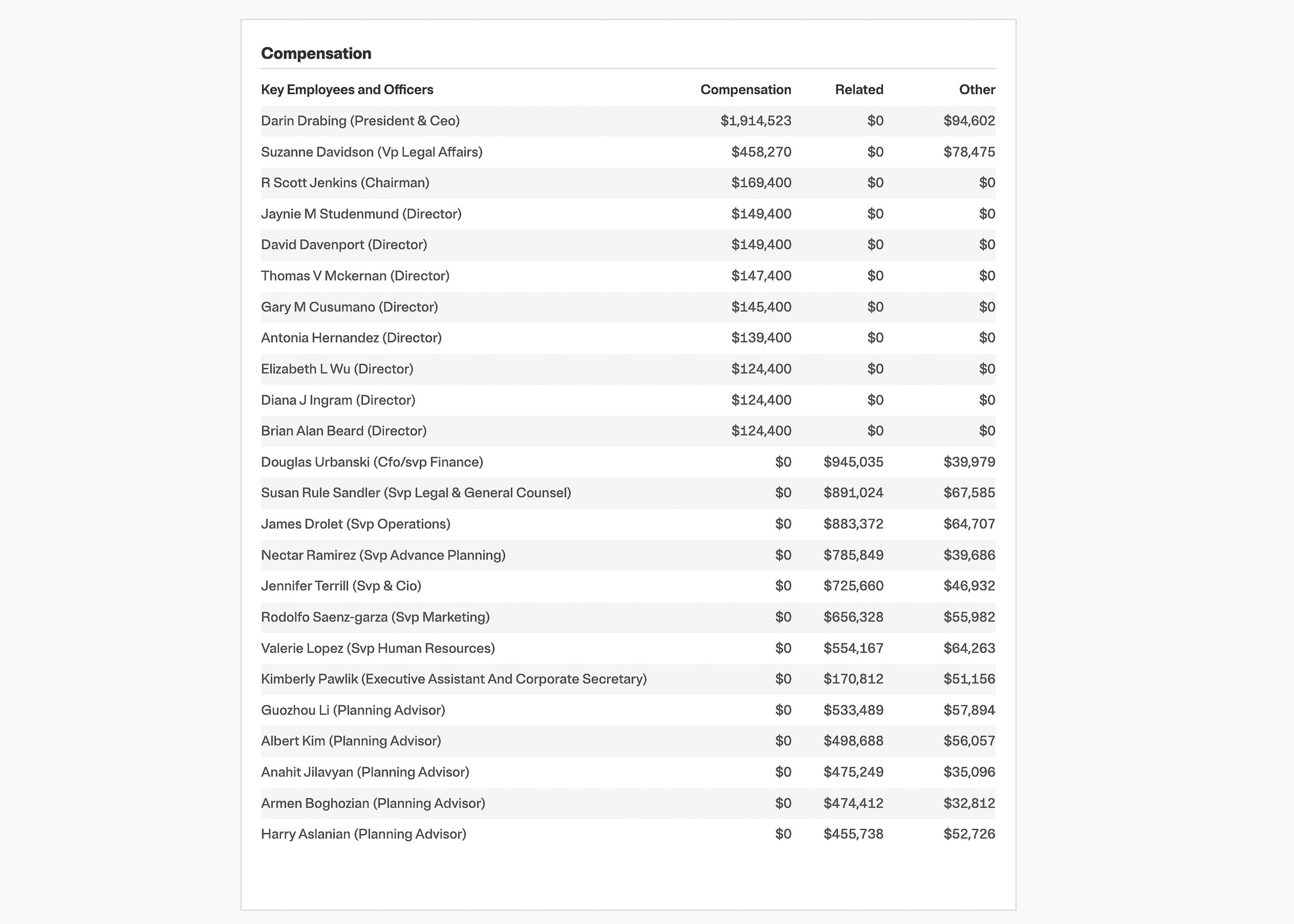
Source: ProPublica Nonprofit Explorer (https://projects.propublica.org/nonprofits/organizations/950743320)
We will let you decide if you feel this is a reasonable amount of pay for board members and executives of a nonprofit organization. You can also decide if Forest Lawn Memorial-park Association is fulfilling its obligations as a nonprofit that justifies the fact that it doesn’t pay taxes. Whatever your conclusion, it clearly shows that Forest Lawn Drive is unlikely to be significantly impacted by a road design that slows most drivers by less than 12 seconds.
Recent Traffic Violence on Forest Lawn Drive
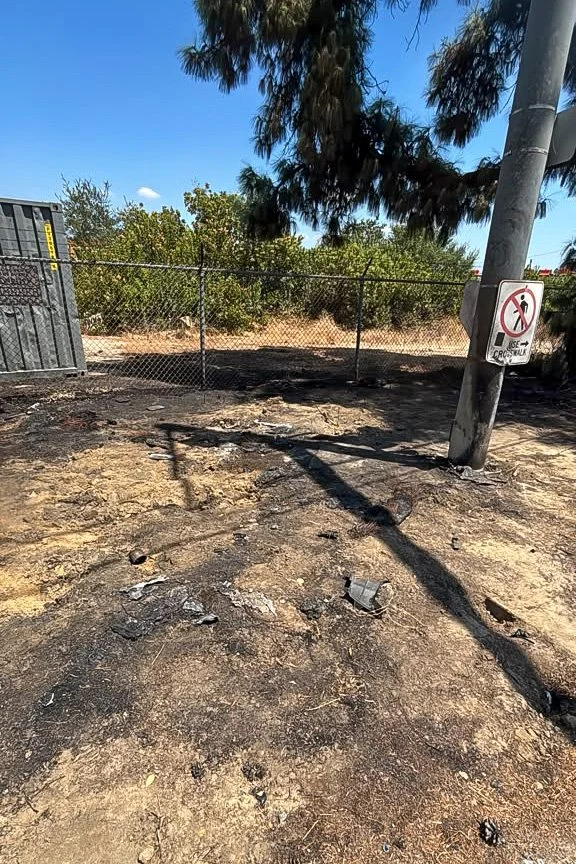
Photo of charred ground on the 5900 block of Forest Lawn Drive depicting the aftermath one day after a single-vehicle crash on August 13, 2026.
Meanwhile, the people of Los Angeles are left to live with the consequences of delaying these safety improvements. On August 13, 2026, a single-vehicle crash on Forest Lawn Drive ended with a vehicle engulfed in flames, killing one person. The cause of the crash remains under investigation. But one thing is clear: the dangers of this road shouldn’t be ignored.
Forest Lawn Drive was dangerous before this crash, and it will remain dangerous without meaningful safety improvements. The City recognized the problem, developed a plan to address it, and was preparing to build it. Now, after years of advocacy and planning, that work has been put on hold, and another life has been lost due to less than 12 seconds of delay that the improvements would have caused most drivers.
I close this article by asking Mayor Bass and Forest Lawn Memorial-Park Association: was it worth it?
Mayor Bass: Unpause the Forest Lawn Drive Safety and Mobility Project.
The project is funded. The safety improvements are ready. It’s time to move forward.
This report builds on SAFE’s more than a decade of advocacy for safer streets in and around Griffith Park, beginning after SAFE founder Damian Kevitt was almost killed in a 2013 collision while cycling in the park and the tragic death of 77-year-old cyclist Andrew Jelmert, who was killed by a speeding driver on Crystal Springs Drive. Since then, SAFE has worked to advance protected bike lanes and other safety improvements throughout Griffith Park and its surrounding streets that connect the Valley to Hollywood, Glendale and eventually to the rest of the city.
Sources
ABC7 Los Angeles. (2026, August 13). 1 killed in fiery crash near Forest Lawn Cemetery in Griffith Park area.
https://abc7.com/post/1-killed-fiery-crash-forest-lawn-cemetery-griffith-park-area/19672308/
Alpert Reyes, E., & Zahniser, D. (2021, May 20). L.A. budget vote boosts spending on parks, relief programs and the LAPD. Los Angeles Times.
https://www.latimes.com/california/story/2021-05-20/la-budget-parks-lapd-homelessness
American Health Care Lawyers Association. (n.d.). Cooperative or 501(c)(3)?
https://ahclaw.com/benefit-post/cooperative-or-501c3/
Beacon Nonprofit. (n.d.). 501(c)(3) requirements: What you need to qualify.
https://www.beaconnonprofit.com/blog/501c3-requirements-what-you-need-to-qualify/
California Department of Transportation. (2025). California manual for setting speed limits.
https://dot.ca.gov/-/media/dot-media/programs/safety-programs/documents/202503-ca-manual-setting-speed-limits-a11y.pdf
City Administrative Officer of Los Angeles. (2025). 2025–26 supplementary information.
https://cao.lacity.gov/content/budget/25-26/2025-26SuppInfo.pdf
City Administrative Officer of Los Angeles. (2026). 2026–27 supplementary information.
https://cao.lacity.gov/content/budget/26-27/2026-27SuppInfo.pdf
City Clerk of Los Angeles. (n.d.). Council file 23-1022-S33.
https://cityclerk.lacity.org/lacityclerkconnect/index.cfm?cfnumber=23-1022-S33&fa=ccfi.viewrecord
City Clerk of Los Angeles. (2025). Fiscal year 2025–26 budget resolution.
https://cityclerk.lacity.org/onlinedocs/2025/25-0600_misc_4-2-25.pdf
City Clerk of Los Angeles. (2026). Budget resolution for fiscal year 2026–2027.
https://cityclerk.lacity.org/onlinedocs/2026/26-0600_misc_Budget%20Reso%20Signed%20by%20City%20Clerk_5-28-26.pdf
City Clerk of Los Angeles. (2026). LADOT FY 2026–27 Budget and Finance Committee letter.
https://cityclerk.lacity.org/onlinedocs/2026/26-0600_misc_11_4-21-26.pdf
City of Los Angeles, Office of the City Administrative Officer. (2021). 2021–22 budget: Supporting information.
https://cao.lacity.gov/content/budget/21-22/SupportInfo/
Forest Lawn Memorial-Park Association. (2025). Form 990, 2024. ProPublica Nonprofit Explorer.
https://projects.propublica.org/nonprofits/organizations/950743320/202523199349301017/full
City of Los Angeles. (n.d.). Open budget: 2025 operating budget.
https://openbudget.lacity.org/#!/year/2025/operating/0/department_name?vis=pieChart
City of Los Angeles. (n.d.). Open budget: 2021 operating budget.
https://openbudget.lacity.org/#!/year/2021/operating/0/department_name?vis=pieChart
Form 1023. (n.d.). Exempt purpose requirements for 501(c)(3) tax exemption.
https://form1023.org/exempt-purpose-requirements-for-501c3-tax-exemption
GrantWatch. (n.d.). Differences between 501(c)(3) and a 501(c)(4) nonprofit organizations.
https://www.grantwatch.com/grantnews/differences-between-501c3-and-a-501c4-nonprofit-organizations/
HBK CPAs & Consultants. (n.d.). Understanding a charitable organization’s exempt purpose.
https://hbkcpa.com/insights/understanding-a-charitable-organizations-exempt-purpose/
International Center for Not-for-Profit Law. (n.d.). International grantmaking.
https://www.icnl.org/resources/research/ijnl/international-grantmaking-6
Los Angeles Department of Transportation. (2023). Forest Lawn Drive active transportation & traffic safety project.
https://ladotlivablestreets-cms.org/uploads/4b3069c72ebc4cc5a63b468e20023426.pdf
Los Angeles Department of Transportation. (2023). Forest Lawn Drive Safety and Mobility Project: Memorial Dr. to Zoo Dr.
https://ladotlivablestreets-cms.org/uploads/410d271b85044b2cb974c64f6812e2f6.pdf
Los Angeles Department of Transportation. (2026). Forest Lawn Drive Safety and Mobility Project FAQ.
https://ladotlivablestreets-cms.org/uploads/6949dd2811d54a288ac768c27cd152e5.pdf
Nonprofit Law Blog. (n.d.). Internal Revenue Code § 501(c)(3): Private inurement.
https://nonprofitlawblog.com/internal_revenu/
ProPublica. (n.d.). Forest Lawn Memorial-Park Association. ProPublica Nonprofit Explorer.
https://projects.propublica.org/nonprofits/organizations/950743320
Robinhood. (n.d.). What is a nonprofit organization (NPO)?
https://robinhood.com/us/en/learn/articles/6uwDgbIUXqCADTMzNrYb30/what-is-a-nonprofit-organization-npo/
RSM US. (n.d.). Protecting tax-exempt status in health care joint ventures.
https://rsmus.com/insights/industries/health-care/protecting-tax-exempt-status-in-health-care-joint-ventures.html
Schneider, M. (2026, May 15). Mayor Bass has intervened to keep Forest Lawn dangerous. Streets For All.
https://www.streetsforall.org/blog/mayor-bass-has-intervened-to-keep-forest-lawn-dangerous
Tax Notes. (n.d.). IRS denies exempt status: Community center operator.
https://www.taxnotes.com/research/federal/irs-private-rulings/letter-rulings-technical-advice/irs-denies-exempt-status-community-center-operator/7j8d4
Tax Notes. (n.d.). Organization’s exempt status revoked for political activity.
https://www.taxnotes.com/research/federal/irs-private-rulings/letter-rulings-technical-advice/organizations-exempt-status-revoked-for-political-activity/1kmxr
Teachfloor. (n.d.). What is 501(c)(3)?
https://www.teachfloor.com/elearning-glossary/what-is-501c3
Zahniser, D. (2026, May 21). L.A. City Council approves $15-billion budget, clearing the way to hire 510 police officers. Los Angeles Times.
https://www.latimes.com/california/story/2026-05-21/la-council-backs-15-billion-budget-hiring-510-officers/