
Why We Should Care About Closing the LA River Bike Path’s 8-Mile Gap
The Current State of the LA River Bike Path
The LA River Bike Path has long been a vision for a healthier, more connected Los Angeles.
In a culture long dominated by car use, prioritizing active transportation represents a meaningful shift toward safer streets, cleaner air, and more equitable access to mobility. This infrastructure can transform the river corridor into a shared public space that connects communities, supports daily travel and recreation, and provides a mode shift for how Angelenos move through their city.
It’s a network of paved multi-use paths, removed from the roadway, that run along portions of the Los Angeles River, providing space for cyclists, rollers, walkers, and runners to travel. Today, the path exists in several major segments rather than as a single continuous corridor. The longest segment is in the southern part of the river, extending from Long Beach through Southeast Los Angeles and Vernon, while another segment runs through the Glendale Narrows and Elysian Valley north of downtown Los Angeles.
While these segments together demonstrate the river’s potential as a regional active transportation corridor, a central 8-mile gap through downtown and nearby neighborhoods remains unbuilt, preventing a fully connected path from the Valley to the ocean.
The Future of the Bike Path
Measure M was meant to bring this vision into reality when it was approved with an overwhelming majority in 2016. Los Angeles County voters approved this half-cent transportation sales tax to fund transit and infrastructure-related projects across the region, including an investment to close the central gap in the Los Angeles River bike path. Approximately $365 million was allocated toward this critical segment, which would connect existing river paths into a continuous, roughly 32-mile active transportation corridor from the San Fernando Valley to Long Beach.
Nearly 10 years later and an 8-mile gap remains, keeping Angelenos from having a true connection from the San Fernando Valley all the way to Long Beach. And since Measure M’s passage, rising construction costs and changes to the overall project design means that current cost estimates exceed the original funding allocation by 3-4 times the amount. These complications have contributed to delays to the estimated completion timeline.
Most recently, Metro released their Draft Environmental Impact Review (EIR) of the project, but there are plenty more steps to go before the construction even starts.
Join Us as We Discuss the Future of the Bike Path
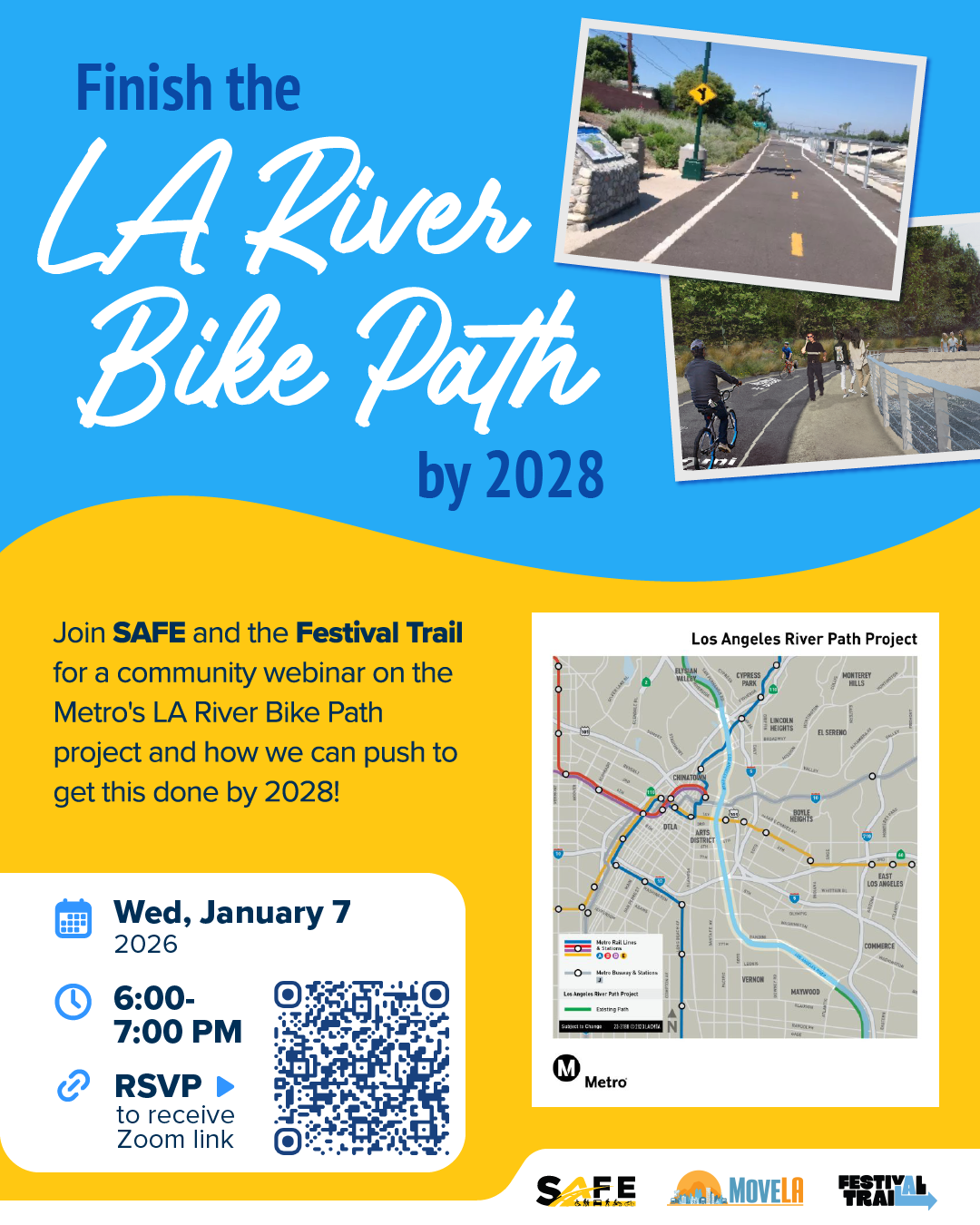
That’s why SAFE and Festival Trail are co-hosting an online webinar on January 7, 6:00-7:00 PM to gather with partner advocates and nonprofit organizations to provide updates on Metro’s LA River Bike Path project, discuss what a fully connected path could mean for our communities, and share a collective call to action to make sure Metro knows this is a priority for the community.
Closing this gap would create a continuous, 32-mile path linking cities historically divided by freeways. It would be a safe corridor for people biking, walking, rolling, and running along the river.
But it’s not just about providing a place for recreation; it’s about building out better connectivity without a focus on cars.
This connectivity would provide access to jobs, schools, transit, parks, and local businesses, especially for communities that have long been underserved by safe transportation options. This would be an opportunity for mode shift and opening up a new alternative for travel around LA County.
Why We Should Care About Closing the Gap
A completed LA River Bike Path would support public health by reducing car dependence and improving air quality in river-adjacent neighborhoods.
Providing a separate option away from cars would also support the city’s ongoing Vision Zero goal.
Just as importantly, it would help reclaim the river as a shared public space, one that brings people together.
This upcoming webinar is an opportunity to learn where the project stands, what decisions are coming up, and how community voices can help shape the outcome. When the community is informed and engaged, projects like this are stronger, more equitable, and more likely to serve the people who need them most.
We hope you’ll join us to learn more and be part of the effort to finally close the gap and create an LA River Bike Path for everyone.