
Streets Are For Everyone Breaks Down the 16 DUI Bills in California’s Legislature This Year
Updated: 31 May 2026
Authors:
Bella Waid Dechant - Policy Intern from UCLA
Stephanie Dena - Policy Intern from SDSU
Kristian Nunez - Policy Intern from USC
Sources:
LA Vision Zero Safety Study 2024: https://ladot.lacity.gov/sites/default/files/documents/la-vision-zero-safety-study-2024.pdf?utm_
DUI Management Information System Dashboards: https://www.dmv.ca.gov/portal/dmv-research-reports/research-development-data-dashboards/dui-management-information-system-dashboards/
DUI and reckless driving stats: https://www.ots.ca.gov/wp-content/uploads/sites/67/2024/09/FY-2023-Annual-Report-Final.pdf#:~:text=Drug%2DImpaired%20Driving%20In%202021%2C%20the%20percent%20of,in%202020%20to%2052.9%20percent%20in%202021.
For a state that prides itself on progressive leadership, California’s complete, utter disregard for human life and the protection of innocent civilians from drunk drivers suggests anything but “progress” when it comes to DUI policy.
Abhorrent and lax DUI laws have long shown the carelessness of legislators and the California DMV regarding the implementation of effective, consistent, and fair consequences for offenders.
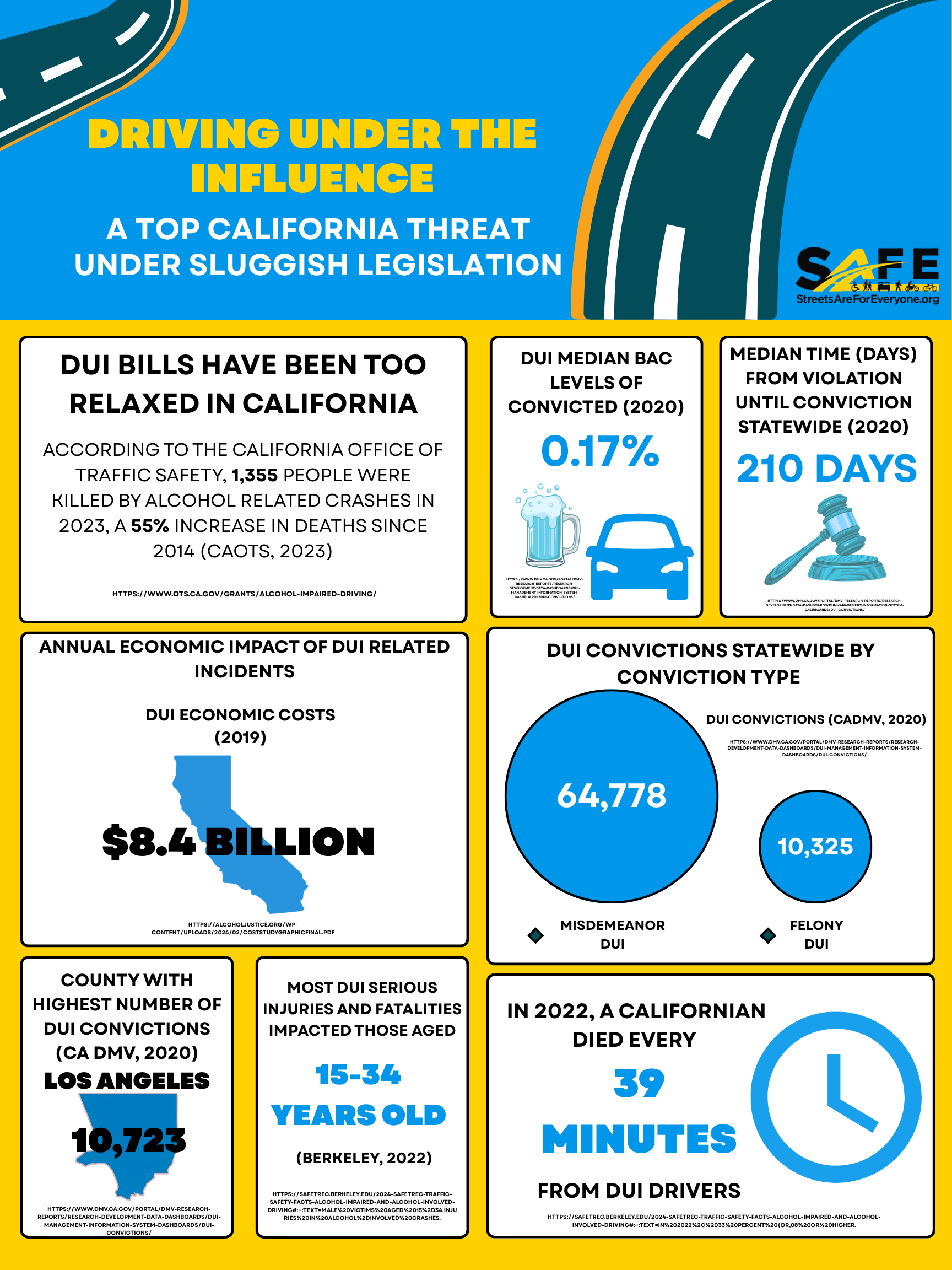
The result of current policy is both alarming and disheartening; in 2023 alone, UC Berkeley reported the deaths of 1,355 Californians due to alcohol-impaired driving. To put this into perspective, that number equates to 1 in 3 traffic-related deaths statewide and averages to the loss of a life once every 43 minutes.
Given these numbers, the question is no longer whether the problem is serious, but rather why our state’s leaders have tolerated it for so long.
One could reasonably argue that both the offenders and California’s leadership have acted with gross negligence, raising the question: When will lawmakers say enough is enough?
This year represents one of the most comprehensive efforts to confront this matter, with a showcase of bills that aim to protect civilians and ensure justice for victims, rather than comfort and appease dangerous drivers.
In response to the staggering loss of life due to conceivably preventable crimes, California lawmakers have set the stage for a tough transition of DUI-related policies. This shift has also been influenced by advocacy from organizations such as CalMatters and its revealing article License to Kill, which highlighted systemic failures in California’s licensing and driver accountability frameworks.
In the 2026 bill cycle, leaders introduced some of the state's strictest and most comprehensive bills we have yet seen.
From increasing immediate DUI penalties to establishing California’s stance on driving under the influence in automated vehicles like Tesla, leaders are preparing to instill harsher penalties and stricter procedures as a means of combating the state’s DUI crisis.
As a non-profit organization focused on transportation policy and road safety, here is what SAFE thinks you should know about this bill cycle.
Definitions to know
Driving under the influence is a criminal offense in which an individual operates a vehicle while under the influence of alcohol and with a Blood Alcohol Content (BAC) of 0.08% or higher. This offense also includes impairment due to prescription drugs, over-the-counter drugs, and illegal drugs. Impairment means the driver is no longer able to physically or mentally operate a vehicle with the same caution as someone sober.
Vehicular manslaughter is a criminal offense in which an individual is killed as a result of the offender’s careless operation of a car. This type of crime typically involves the killing of a victim without the intention to do so.
Vehicular manslaughter while intoxicated
Vehicular manslaughter while intoxicated means a driver who is under the influence causes the death of a victim due to their careless operation of a vehicle.
Gross vehicular manslaughter goes beyond the simple carelessness of vehicular manslaughter and involves a driver operating their vehicle with total recklessness and a disregard for human life.
Gross vehicular manslaughter while intoxicated
Gross vehicular manslaughter while intoxicated means a driver who is under the influence causes the death of a victim due to operating a vehicle extremely recklessly.
Interlocking Ignition Devices (IID)
When installed in a vehicle, the device requires the driver to breathe into a receptacle that reads their Blood Alcohol Content (BAC). If the driver has been drinking, the IID will prevent the person from starting their car.
Context
The DMV will suspend an individual's license for 6 months if they accumulate 4 points on their driving record within 12 months, 6 points within 24 months, or 8 points within 36 months.
Under current law, vehicular manslaughter charges only dock 2 points from an offender’s driving record, highlighting an immense disparity between the seriousness of the crime committed and the consequence faced by the offender.
What is the difference between an Assembly Bill(AB) and a Senate Bill(SB)?
Assembly Bill(AB):
These bills originate in the California State Assembly and are sent to the California State Senate for approval before becoming law.
Senate Bill(SB):
These bills originate in the California State Senate and are sent to the California State Assembly for approval before becoming law.
So,
A bill can start in either the Assembly or the Senate, but must be approved by both bodies to become law. These lawmaking bodies are two halves of the whole state legislature.
2026 DUI Bills
SAFE is proud to support SB 907, SB 953, AB 1546, AB 1662, AB 1685, AB 1686, AB 1687, AB 1747, AB 1748, AB 1814, AB 1830, AB 2276, and AB 2502 to increase offender accountability and promote traffic safety.
Note: Bill language is constantly changing and being refined by the legislative process. The data in this article is a brief summary of each bill and may lack exact details. It is accurate as of 10 April 2026. Each bill is hyperlinked to its current language.
SAFE’s 2026 DUI Co-sponsored Bills
SAFE is proud to sponsor AB 1814, AB 1685, and AB 1687
Note: Bill language is constantly changing and being refined by the legislative process. The data in this article is a brief summary of each bill and may lack exact details. It is accurate as of 27 May 2026. Each bill is hyperlinked to its current language.
Bills That Prevent Repeat DUI Before It Happens
SB 1156 - (Currently in the Assembly)
SB 1156SB 1156(Caballero) prohibits drivers with certain driving offenses from purchasing alcohol for a period of 3 to 10 years, depending on the offense and its severity level.
SAFE is Neutral on SB 1156.
AB 1605 - Died in Assembly Appropriations Committee
AB 1605 (Ransom) limits drivers from purchasing alcohol when their offense occurs within ten years of two or more severe offenses, such as vehicular manslaughter. The bill would require all establishments that sell alcohol to check each customer's driver’s license, an extension of the responsibilities already imposed by drinking age laws. Offenders subject to the alcohol purchase limits will have visible designations marked on their identification cards from the California Department of Motor Vehicles to make it easier for establishments to recognize these individuals and turn them away from service(s).
AB 1814 - Bill died in the Assembly Appropriations Committee
AB 1814 (Alanis) requires the state to create a new DUI training course for law enforcement officers by July 1, 2027, to improve how officers detect and handle impaired driving. The course must be at least 3 hours long and cover topics like field sobriety tests, drug effects, signs of impairment, report writing, and courtroom testimony. Officers assigned mainly to traffic enforcement must complete the training within 1 year of assignment and repeat it every 2 years, or take an equivalent approved course.
SAFE wasa co-sponsor of AB 1814 and hopes to work with the author on a similar bill in the next legislative term.
AB 1830 - Currently in the Assembly for a full Floor Vote
AB 1830 (Petrie-Norris, Lackey, and Ransom) is an extension of AB 366. It would require all drivers convicted of their first DUI to install an interlocking ignition device, or IID, in their car, as ordered by a court, to ensure they do not drive the vehicle while under the influence of alcohol. Preventing repeat drunk driving offenses before they happen creates safer streets for both pedestrians and drivers.
SAFE Supports AB 1830.
AB 1867 - The bill was pulled by the author and has died
AB 1867 (Tangipa) increases penalties for repeat DUI offenders by restricting access to alcohol. The bill would impose a lifetime ban on purchasing alcohol for individuals convicted of a third DUI within 10 years who are sentenced to state prison, and require the DMV to issue identification marked “Repeat Serious DUI Offender,” which may be used by alcohol retailers to deny sales. Although aimed at improving public safety, the measure raises concerns about how a lifetime purchasing ban would be enforced, the implications of labeling individuals on state-issued IDs, and the lack of clear implementation details, all of which warrant amendments.
SAFE took a position of Opposed Unless Amended for AB 1867.
AB 2502 - Currently in the Senate
AB 2502 (Pellerin) includes drivers of vehicles with up to level 3 automation and BAC levels exceeding 0.08 in DUI offenses. Studies show that an alarming number of drivers with co-pilot vehicle systems have become exceedingly comfortable with driving under the influence. This bill creates a strict framework for addressing DUI’s of this type and sets the standard for how California views driving under the influence, regardless of vehicle automation level.
Vehicle automation framework
Level 1: The vehicle supports steering or braking/acceleration, but the driver is fully responsible for driving.
Level 2: The vehicle handles steering and braking/acceleration simultaneously under specific circumstances, but the driver must watch the road and be able to take over at all times. The best-known vehicle in this range of automation is the Tesla.
Level 3: The vehicle can manage all aspects of driving, but the driver must be available when requested.
SAFE Supports AB 2502.
Bills That Make DUI and Vehicular Manslaughter Penalties Harsher
SB 907 - Currently undergoing a Senate Floor Vote
SB 907 (Archuleta) strengthens penalties for repeat DUI and related driving offenses by expanding sentencing enhancements and increasing penalties for repeat and serious offenders. The bill imposes an additional 3-year enhancement for each prior DUI-related conviction within 10 years for specified DUI offenses, increases penalties for certain hit-and-run offenses committed within 10 years of prior DUI, reckless driving, or gross vehicular manslaughter convictions, and expands required court advisements in DUI cases to include dismissed allegations and pleas to lesser offenses. The bill also establishes related state-mandated local programs by creating new sentencing enhancements and increasing terms of imprisonment.
SAFE Supports SB 907
AB 1686 - Bill has failed to pass the Committee on Public Safety
AB 1686 (Lackey) expands the circumstances under which DUI offenses can be charged as felonies rather than just misdemeanors. Under this bill, a person with 1 or 2 prior DUI offenses within 10 years could have a new DUI charged as either a misdemeanor or a felony, instead of only a misdemeanor as under current law. This increases potential penalties, including longer jail sentences and stricter consequences, and is meant to treat repeat DUI behavior more seriously and earlier, rather than waiting until a 3rd offense to pursue felony charges.
SAFE Supports AB 1686
AB 1747 - Bill has failed to pass the Committee on Public Safety
AB 1747 (Sanchez) increases the penalty of vehicular manslaughter while intoxicated from being charged as either a misdemeanor or a felony to a mandatory felony. Current law allows judges to charge individuals responsible for vehicular manslaughter while intoxicated with either a misdemeanor or a felony, leading to differences in procedure and a lack of consistency. This bill will target this problem and require that all convictions of this nature be dealt with in the same manner, leading to an increase in the consequences faced by impaired drivers who have recklessly taken lives.
SAFE Supports AB 1747.
Bills That Add Points or Keep Points on a Driver’s Record
SB 953 - Currently undergoing a Senate Floor Vote
SB 953 (Niello) ensures that serious driving offenses like vehicular manslaughter still impact a driver’s record even if the case is dismissed after completing a diversion program. Specifically, the bill requires the DMV to assign 2 violation points for misdemeanor vehicular manslaughter cases dismissed through diversion, as if the person had been convicted. This prevents drivers from avoiding consequences on their driving record for severe offenses and helps ensure accountability and public safety.
SAFE Supports SB 953.
AB 1662 - Currently undergoing an Assembly Floor Vote
AB 1662 (Wilson) changes how diversion programs affect a driver’s record by requiring that even if a misdemeanor case (like certain traffic offenses) is dismissed after completing diversion, the court must still report it to the DMV. The driver will still receive the appropriate points. This means drivers can no longer avoid license points through diversion for offenses that normally carry points, helping ensure accountability and maintaining accurate driving records.
SAFE Supports AB 1662.
AB 1685 - Currently undergoing an Assembly Floor Vote
AB 1685 (Lackey and Petrie-Norris) increases California’s driving record point system from two points to three for vehicular manslaughter while intoxicated and vehicular manslaughter as a result of negligent behavior, including fraudulent schemes to garner insurance money. This bill will increase the consequences of driving recklessly and/or under the influence by adding more points to offenders' driving records, thereby incentivizing safer driving practices and keeping repeat offenders off California roads sooner.
SAFE is co-sponsoring AB 1685.
Bills That Take Licenses Away Faster and for Longer
AB 1546 - Currently undergoing an Assembly Floor Vote
AB 1546 (Schultz) increases penalties for repeat DUI offenses within 10 years by expanding eligibility for felony (wobbler) charges and longer jail terms. Specifically, a third DUI may be punished by 120 days to 1 year in county jail or 16 months to 2 or 3 years, and a fourth or subsequent DUI within 10 years is punishable as a felony with similar prison terms. The bill also extends driver’s license revocation periods to 4 years for individuals with three prior DUIs and 5 years for those with four or more. It requires ignition interlock devices for 36 months (3 priors) or 48 months (4+ priors). SAFE supports the goal of reducing repeat DUI offenses but seeks amendments to ensure the enhanced penalties are applied fairly and effectively.
SAFE Supports If Amended for AB 1546
AB 1687 - Currently undergoing an Assembly Floor Vote
AB 1687 (Lackey) specifically targets repeat DUI offenders by authorizing the immediate removal of an individual's license if they have three or more DUI convictions within ten years. This bill will also require that the period during which this offender’s driver’s license is revoked be increased from three to eight years to heighten accountability for repeat offenders and incentivize responsible driving. If an offender subject to these consequences qualifies, their driving prohibition can be reversed if they agree to install a vehicle ignition interlock device.
SAFE is co-sponsoring AB 1687.
AB 1748 - Bill has failed to pass
AB 1748 (Sanchez) increases the amount of time that an individual will lose their license if convicted of a DUI. The bill introduces a one-year, immediate license suspension for DUI offenders, but 16 months if the offender had a BAC of at least 2.0 or refused to take a chemical test. Additionally, the bill specifies longer license-suspension terms for repeat offenders based on the number of prior DUI convictions in a 10-year period. This bill would also require that individuals convicted of four or more DUIs within ten years have their licenses permanently revoked to protect the public from persistent offenders.
SAFE Supports AB 1748.
AB 1874 - Bill died in the Assembly Appropriations Committee
AB 1874 (Wilson) clearly defines the starting period for a license suspension or permanent license revocation. This bill will clarify that both periods begin when an offender is released from custody, not while the offender is behind bars.
SAFE supports AB 1874.
Conclusion
California can no longer afford to tolerate policies that fail to hold dangerous drivers accountable.
The loss of life caused by impaired and reckless driving is not inevitable; it is the result of gaps in enforcement, inconsistency in consequences, and a system that too often prioritizes leniency over public safety.
The 2026 DUI bill cycle represents a critical turning point. These measures signal a long-overdue shift toward accountability, consistency, and a renewed commitment to protecting innocent lives on our roadways.
But legislation alone is not enough. Meaningful change requires public awareness and engagement.
We urge individuals, advocates, and community leaders to take action, contact your local Assemblymember or Senator, submit letters of support, and make your voice heard in support of policies that prioritize safety and justice for victims.
California has the opportunity to lead with purpose and urgency. Now is the time to act.